The Future of Hospitality
Bringing the Thrill Back to Short-Term Rentals
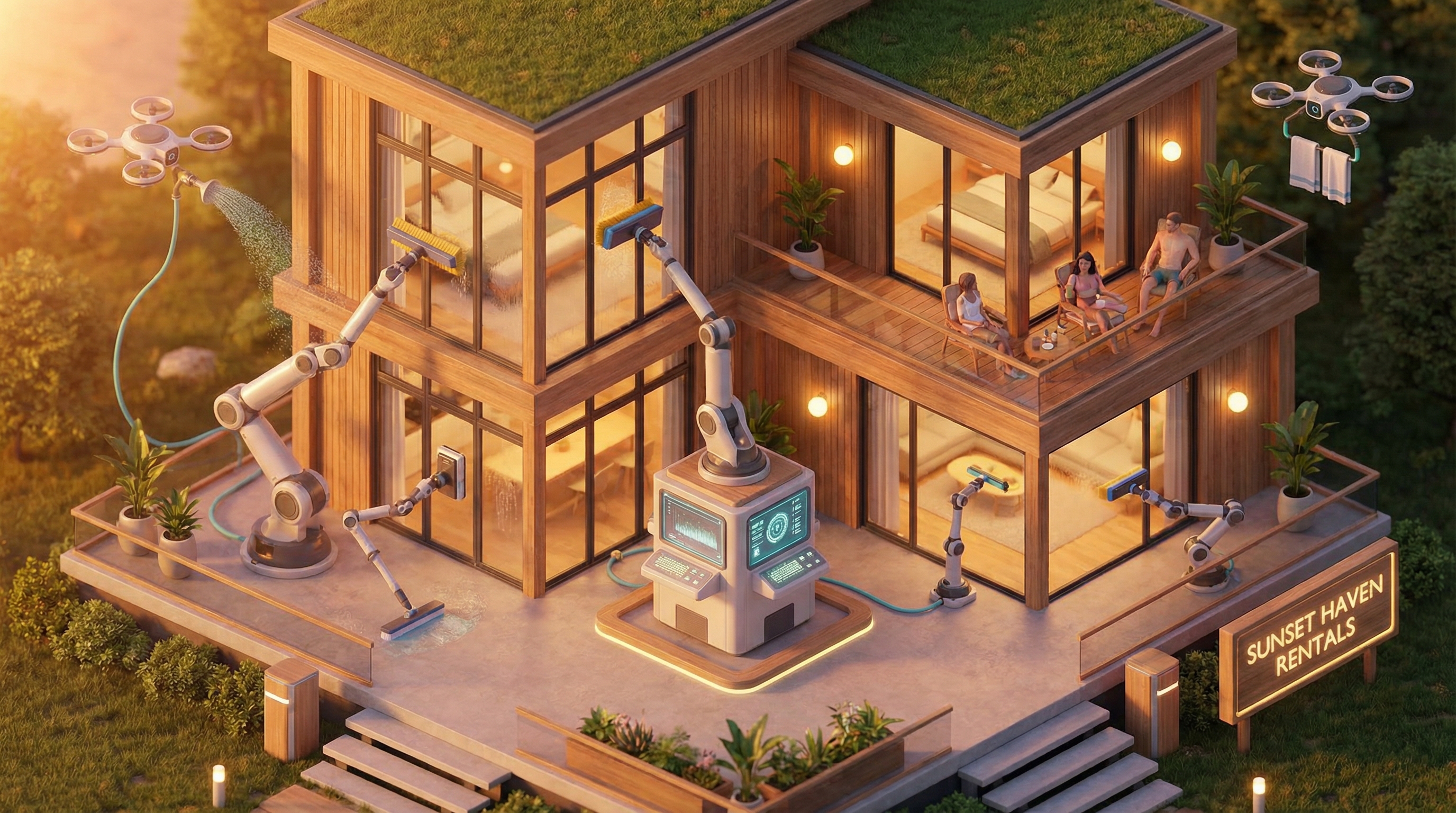
Rafat Ali's recent piece in Skift, "The Thrill Is Gone: Airbnb and the Crisis of Imagination in Short-Term Rentals", is one of the sharpest diagnoses of the industry I've read. His core argument: Airbnb just hired Meta's former head of generative AI, but no CTO can solve a structural problem. The platforms control the digital layer. They don't control the physical layer.
Ali is right. But his piece ends with a question: what would bring the thrill back? He admits he's not sure. I think I am.
The Structural Trap
Ali nails the core constraint. Airbnb controls discovery, booking, messaging, policies, payments. Everything before and after the stay. The actual stay is controlled by millions of hosts making millions of individual decisions about linens, repairs, air conditioning, noise, and checkout chores.
As Ali puts it: "Airbnb functions less as a hospitality brand than as an adjudication system with a checkout flow."
Hotels can innovate on rooms, service, design, staffing, amenities. When a Marriott wants to change something, it changes the product guests actually touch. Airbnb can only innovate on the interface.
This matters because consumer sentiment has shifted. According to an Upgraded Points survey from October 2025, 62% of Americans now prefer hotels over short-term rentals. The cleaning fee backlash, the checkout chore lists, the inconsistency between listing photos and reality. These aren't platform failures. They're supply-side failures that platforms can't control.
Get more insights like this
Weekly STR tech updates. No spam.
The Startup Graveyard
A decade ago, a wave of companies tried to solve this problem. They weren't marketplaces. They were trying to be hospitality companies, providing consistency, operations, and quality control at scale.
They all failed.
| Company | Peak Valuation | Exit | Collapse |
|---|---|---|---|
| Sonder | $2.2B (2021 SPAC) | Chapter 7 liquidation (Nov 2025) | 100% |
| Vacasa | $4.5B (2021) | Acquired by Casago for ~$130M (Apr 2025) | 97% |
| Inspirato | $1.1B (2022 SPAC) | Acquired by Exclusive Resorts for $59M (Dec 2025) | 95% |
The thesis was right. Hospitality needs someone to control the physical layer. The execution model was wrong. These companies tried to solve an operations problem with people. They hired thousands of cleaners, maintenance crews, guest service agents. They took on the OPEX of a hotel chain without the margins of a hotel chain.
Hospitality is operations disguised as real estate disguised as tech. Short-term rentals look scalable until you meet the reality of cleaning coordination, maintenance dispatch, customer support, local regulation, and a product that physically degrades. When venture capital stops funding a category, it's telling you the thesis is exhausted.
The Uber vs. Waymo Shift
Here's the analogy that matters: Uber versus Waymo.
Uber built a platform that coordinates humans. Drivers make individual decisions. Quality is variable. Trust comes from ratings and insurance. It's a marketplace with a dispatch layer.
Waymo built a service where execution is controlled end-to-end. No human variability. The car drives the same way every time. Quality is a software problem, not a people problem.
Current hospitality is the Uber model. Platforms coordinate fragmented supply. Hosts make decisions. Quality varies wildly. The platform handles payments and disputes. You might get a spotless apartment with a thoughtful welcome note, or you might find hair in the shower and a broken coffee maker. The platform has no idea which one until you complain.
The next evolution is the Waymo model. Software that actually runs the operation, not just connects parties.
From People Problem to Software Problem
The property management layer exists because operations are hard for humans. Cleaning coordination, maintenance triage, guest communication, calendar management, compliance. That's why property managers charge 20-30% of revenue. The fee exists because the operational job is manual. Sonder, Vacasa, Inspirato tried to solve this with people. The next wave will solve it with software.
If software replaces that labor, not assists it, replaces it, the economics restructure entirely. And here's what most people miss: solving operations isn't the end goal. It's the prerequisite for everything else.
Chesky keeps describing an AI concierge that knows you, plans your trip, handles everything. It's a compelling vision. But Airbnb can build the smartest AI assistant in the world and still not deliver on that promise. Why? The AI can see you're arriving on a red-eye with kids and suggest having groceries stocked and to book a babysitter for the night. It can't guarantee any of that actually happens before you walk through the door at 6am, exhausted. The service is still executed by fragmented humans making independent decisions.
The real unlock is combining both: an executive assistant that understands what you want AND a concierge system that can actually deliver it. That means autonomous systems that run the entire operational chain: triage an issue, find a vendor, schedule the repair, coordinate access, verify completion, update the guest. The chain only works if the chain completes. Without operational control, you have a very smart chatbot connected to a very unreliable supply chain.
The Experience Engineering Shift
When operations become software, property managers stop being logistics coordinators. They become experience engineers.
Think about what becomes possible: the system knows a couple booked a weekend getaway. It can ask if it's a special occasion. If they say anniversary, it can offer rose petals, champagne, a dinner reservation, all selected, paid, organized, and delivered without the guest touching a spreadsheet or making five phone calls. The upsell isn't a pop-up ad. It's genuine hospitality, automated.
This is what loyalty actually looks like in travel. Not points programs. Not discounts. Stays that feel like someone who knows you prepared everything. That's why hotels have concierges. The platforms have never been able to replicate it because they don't control the delivery.
| Airbnb Today | Full-Stack Platform |
|---|---|
| AI answers questions | AI orchestrates services |
| Guest coordinates logistics | Platform handles logistics |
| Experience depends on host | Experience is software-enforced |
| Loyalty = habit | Loyalty = genuine delight |
The travel super app everyone keeps predicting isn't about bundling flights and hotels into one checkout. It's about a platform that actually manages the entire trip, from planning to execution to the moment you walk through the door. That requires operational control. Everything else is just aggregation.
The Bottom Line
The company that wins the next decade of hospitality won't be the one with the best interface. It won't even be the one with the best AI. It will be whoever combines intelligent personalization with reliable execution.
Airbnb can build an AI concierge. But without controlling operations, the concierge is just making promises it can't keep. The winner will be whoever turns hospitality from a people problem into a software problem, not to cut costs, but to finally deliver the experience the platforms have been promising for a decade.
Airbnb built the marketplace. The next era belongs to whoever builds the machine that runs it.