Resident Revolt
Why 27% of Apartment Dwellers Hate Your Business Model
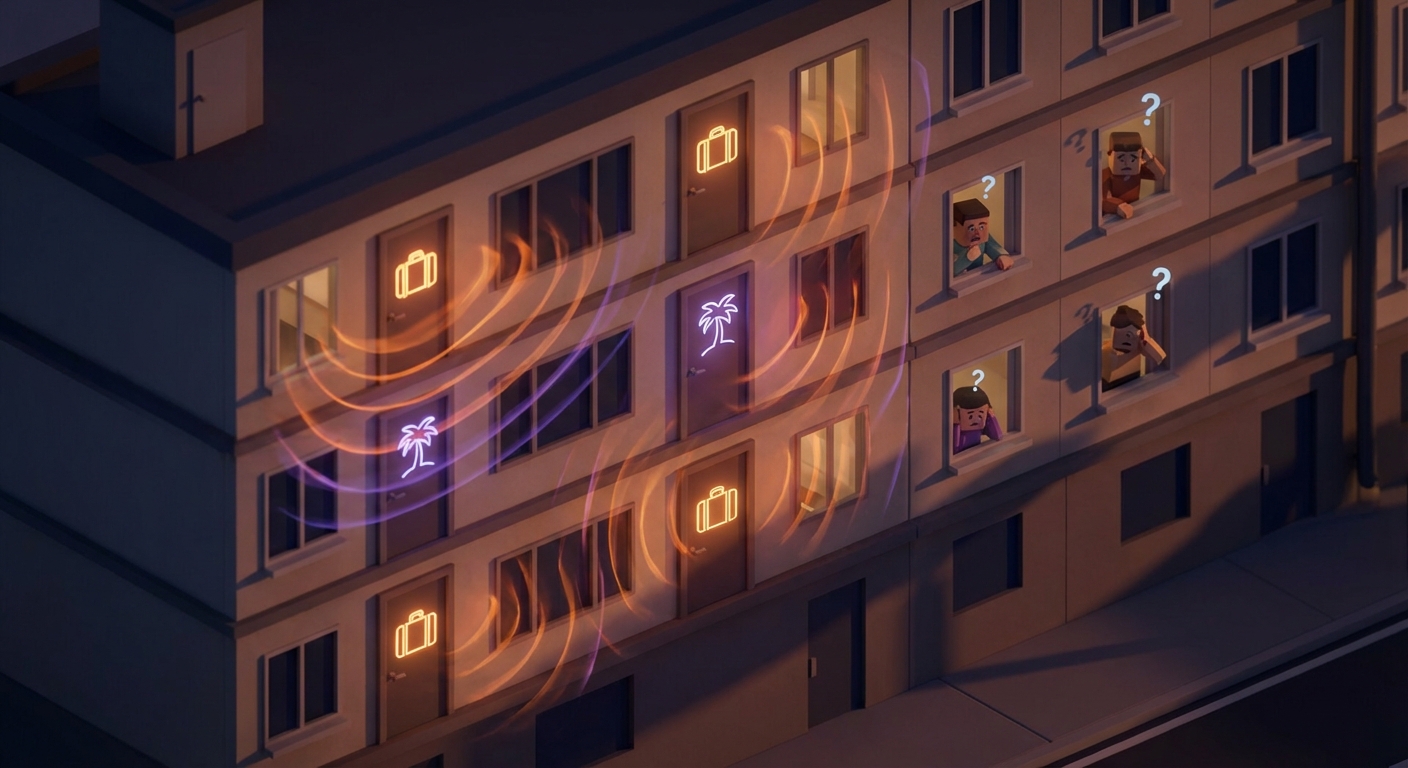
The vacation rental industry loves to talk about "disruption." We disrupted hotels. We disrupted travel. We're the sharing economy success story.
What we don't talk about: we also disrupted apartment buildings. And the residents who live there full-time are increasingly furious about it.
The Sentiment Data Nobody Wants to Hear
Here's a number that should concern every operator running STRs in multifamily buildings: according to a National Apartment Association survey, 27% of renters have a negative opinion of short-term rentals in their community.
More than one in four. And it gets worse.
49% cite security as their top concern. Strangers with codes to the building. No idea who's walking the halls.
32% cite noise. The "one-night party crowd" stereotype exists because it happens often enough to be a pattern.
19% say they would not rent in a building that allows STRs at all. That's a leasing liability for property owners.
Get more insights like this
Weekly STR tech updates. No spam.
The Party Risk Is Actually Low (But Perception Matters)
Here's where it gets nuanced. The actual incident rate is far lower than the perception suggests.
Airbnb's 2024 data shows that party allegations occurred in fewer than 0.06% of US reservations. That's 6 in 10,000 bookings.
Since implementing their global party ban in 2020, Airbnb has seen a 55% year-over-two-year drop in party report rates globally. Their screening technology deterred approximately 51,000 people during the 2024 Memorial Day and Fourth of July weekends alone.
Property damage requiring reimbursement over $1,000 occurred in only 0.02% of global reservations.
The data is clear: actual incidents are rare. But perception is reality for residents who hear about the horror stories and assume they're common.
The "Airbnb-Friendly Apartments" Reality Check
Airbnb's partnership program with building owners has enrolled over 750 buildings and 200,000+ units across the US. Major operators like Greystar and Equity Residential are participating.
But here's the buried finding: only ~2,000 renters have actively hosted, generating $14 million in earnings over two years. That's an implied adoption rate of roughly 1% of eligible units.
The feared "building turning into a hotel" scenario hasn't materialized. Most renters in AFA buildings don't host at all. The ones who do tend to be occasional hosts earning supplemental income.
This data should reassure building owners considering the program. The adoption rate is manageable. The "slippery slope to chaos" argument doesn't hold up empirically.
Where Noise Monitoring Is Now Mandatory
The regulatory environment has responded to resident complaints with hardware requirements. Depending on jurisdiction, noise monitors aren't optional.
| Jurisdiction | Device Requirement | Response SLA |
|---|---|---|
| New Orleans, LA | Mandatory for Commercial STRs | N/A |
| Hallandale Beach, FL | Mandatory (exterior wall) | Agent notifies within 20 min, arrives within 60 min |
| Riverside County, CA | Mandatory outdoor monitors | Quiet hours 10pm-7am |
| Miami Beach, FL | Strict limits (60/50 dB) | Fines $500-$20,000 |
Hallandale Beach's ordinance is particularly aggressive: your designated agent must be willing and able to be physically present at the rental within 60 minutes of notification.
These aren't theoretical rules. They're actively enforced. If you're operating in these markets without noise monitoring hardware and a physical response plan, you're taking on substantial compliance risk.
The HOA Wildcard
There's a data gap nobody talks about: no authoritative national statistic exists on what percentage of HOAs have banned STRs.
But the qualitative evidence suggests restrictions are widespread. Many associations don't explicitly "ban STRs" but implement minimum lease terms (30 days, 3 months, 1 year) that effectively prohibit nightly rentals.
HOA bylaws are subject to change via owner votes. Your ability to operate can disappear with a single board meeting.
The operational advice is clear: treat every HOA/condo asset as "restricted until proven otherwise." Due diligence must include reviewing CC&Rs for minimum lease duration clauses, not just explicit STR bans.
The Financial Stakes
The cost of getting resident relations wrong is steep and rising.
Miami Beach fines for STR violations range from $500 to $20,000. In Riverside County, fines can reach $5,000 with a dedicated enforcement team focused on "party house" complaints.
But the indirect costs are often worse. A building that loses long-term residents because of STR-related complaints faces leasing challenges that far exceed the revenue from hosting fees.
The "Controlled Adoption" Framework
Smart operators are moving toward what I call "Controlled Adoption": enabling STRs while actively managing the downside.
Cap participation. Limit STR-enabled units to 2-5% of the building. This prevents the "hotel takeover" perception.
Mandate noise monitoring. Install devices in every STR unit regardless of local law. It's cheap insurance against complaints.
Enforce response SLAs. If you can't physically respond to an incident within 60 minutes, you need a local partner who can.
Track complaints per occupied night. This is the KPI that predicts regulatory trouble. Industry platforms report incidents "per reservation," but that's too coarse. Track your own metrics.
The Pilot Strategy
Before rolling out STRs across a portfolio, validate the model:
Days 1-30: Survey residents. Ask about concerns. Measure baseline sentiment.
Days 31-60: Pilot 2-3 units. Install noise monitoring. Track complaints.
Days 61-90: Review data. If complaints per occupied night are below threshold, expand cautiously.
The operators who skip the pilot phase often face regulatory blowback that could have been avoided with 90 days of data collection.
The Bottom Line
Resident sentiment is the single biggest risk factor for STRs in multifamily buildings. It's not the regulations. It's not the platforms. It's the people who live there full-time and vote with their lease renewals.
27% negative perception. That's the headwind you're fighting.
The operators who succeed in this environment aren't the ones who maximize hosting revenue. They're the ones who minimize complaints. Who install the hardware. Who respond in 60 minutes. Who cap adoption before neighbors revolt.
The vacation rental industry disrupted a lot of things. But you can't disrupt the person who lives next door.